A water quality report is written to show the water meets standards, not to explain your plumbing. Still, four lines on it account for a surprising share of service calls: hardness, pressure, disinfectant and pH. This post reads those lines for a house on City of Temple Terrace water. The figures come from the city's 2024 water quality report and its May 2026 water treatment master plan, so check the newest report for current values.
| Line on the report | What the city publishes | Where it shows up at home |
|---|---|---|
| Hardness | Described as very hard, currently more than 300 mg/L (about 17.5 grains per gallon, our conversion) | Scale in tank heaters, tankless heat exchangers, aerators and showerheads |
| Pressure | Typically 55–65 psi | Hose bibs, supply lines, regulator and expansion tank checks |
| Disinfectant | Chlorine, average 2.00 ppm (range 0.8–2.8); no chloramine | Mostly a reminder not to compare reports across utilities |
| pH | 7.9 at Whiteway, 7.5 at Sunningdale | Not the headline for most repairs |
Hardness: Why Tank Heaters Show It First
Hard water carries dissolved calcium and magnesium. Heat it and some of that drops out as scale. Plumbers see the same pattern on hard water everywhere (this is an inference from the general behavior of hard water, not a finding about your house): sediment collects at the bottom of a tank heater, coats electric elements and shortens their life, and clogs the flow sensor and heat exchanger on a tankless unit. Faucet aerators and showerheads fill with white grit.
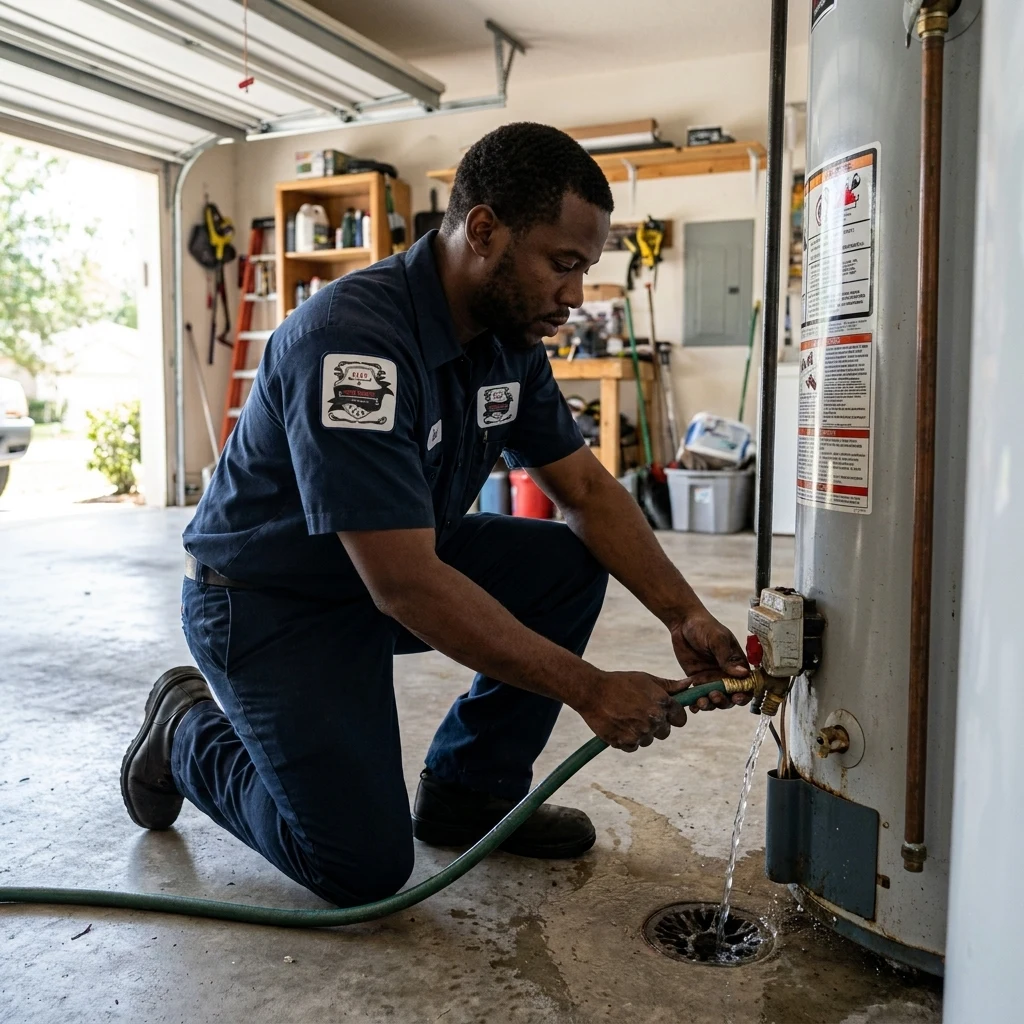
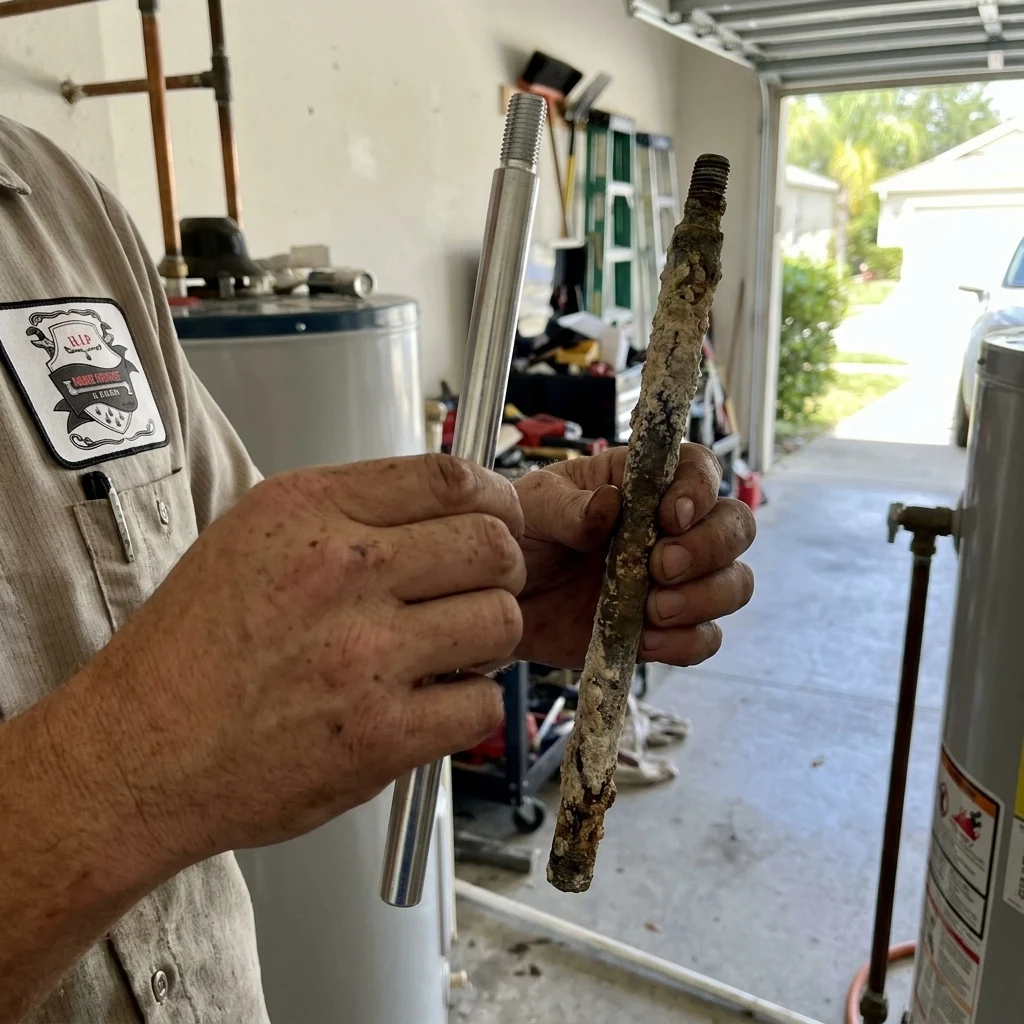
The routine that answers it is short. Flush a tank heater by running a hose from the drain valve until the water runs clear. Check the anode rod every few years; it is the sacrificial part that corrodes so the tank does not. Descale a tankless unit every 12 to 24 months, leaning to the short end on hard water; that flush runs $200–$400. A worn anode, element or thermostat repair is usually $150–$450. If a tank over roughly 10 to 12 years old springs a leak, replacement at $1,200–$2,500 installed is the honest answer; a four-year-old unit with a failed element is a repair. See water heater repair and replacement for both paths.
Pressure: 55 to 65 psi Is Comfortable, but Your House May Differ
The city gives 55–65 psi as typical for its system. That is a system figure, not a reading at your tap. An inexpensive pressure gauge screwed onto a hose bib tells you the real number in about thirty seconds. Plumbing codes generally cap household static pressure at 80 psi, so a reading well above that points to a failing pressure regulator, a $350–$900 repair. Check the gauge again while the water heater is heating with no fixture open; a sharp climb suggests the system has nowhere to put expanding water. An expansion tank, $250–$450, is the usual fix.
Chlorine, Not Chloramine
The city lists chlorine as its disinfectant and reports no chloramine. Tampa's 2025 report lists chloramine at 3.6 ppm and a hardness of 211 mg/L, so a house on Tampa water reads a different report altogether. Do not carry numbers from one utility's page to another; start with the bill, as covered in who to call for water and sewer problems.
What the Report Cannot Tell You
The report describes water as it leaves the city's system, on average. It does not measure what happens after the meter: the age of the pipe in your wall, scale already built up in a decades-old tank, or sediment stirred loose in a galvanized line. Two houses on the same street can see the same city numbers and very different plumbing wear. Use the report to know what the water tends to do, and let a visual check of your own equipment tell you where yours stands.
A Ten-Minute Check You Can Do Today
- Read the water heater's label and note the date code or serial prefix.
- Screw a pressure gauge on a hose bib and write the number down.
- Unscrew a kitchen faucet aerator; scale in it tells you what the heater's tank looks like.
- Look for a rust-colored trail under the relief valve discharge pipe.
- Look for an expansion tank near the heater; if you find none, mention it when you call.
A water softener is a separate decision and a water-treatment company's field, not ours, but any plumber should say whether the pressure and expansion setup suits it. Older homes in Temple Terrace Estates and our older Temple Terrace homes guide go further on aging supply lines.
Heater older than ten years and acting up?
Tell us the age on the label and what it is doing. We will say whether it sounds like a repair worth making or a replacement to plan for.
CALL 813-733-7188Water Report and Plumbing Questions
A yearly flush is a sensible interval for most tank heaters, and it matters more on hard water. Run a hose from the drain valve until the water clears. If the valve is clogged or the tank is old, ask a plumber to do it first.
Plumbing codes generally cap static pressure at about 80 psi. A hose-bib gauge reading above that, or one that climbs sharply while the heater runs, means a regulator or expansion tank problem worth fixing before a fixture fails.
Not necessarily. The city's figure describes its system typically. Pipe size, elevation and a regulator inside your house can all change what reaches the tap, so measure at a hose bib to know your own number.
If it is not leaking and works well, you can keep it and plan the budget. Once a leak appears in the tank, repair does not help. Expect $1,200–$2,500 installed for a tank replacement.