Plumbing in Carrollwood, Built Out in the 1980s
Carrollwood, about 7.3 miles northwest of Temple Terrace City Hall, was platted from 1959 but built out in a different decade than most people assume. Among 8,068 single-family parcels the median year is 1981, only 10.9 percent date from before 1970, and 65.5 percent went up between 1978 and 1997.
That window overlaps the years polybutylene supply pipe was sold across the country, roughly 1978 to 1995. It does not mean any given Carrollwood house has it. It means a pinhole call here gets one question before every other: what is the supply line made of?
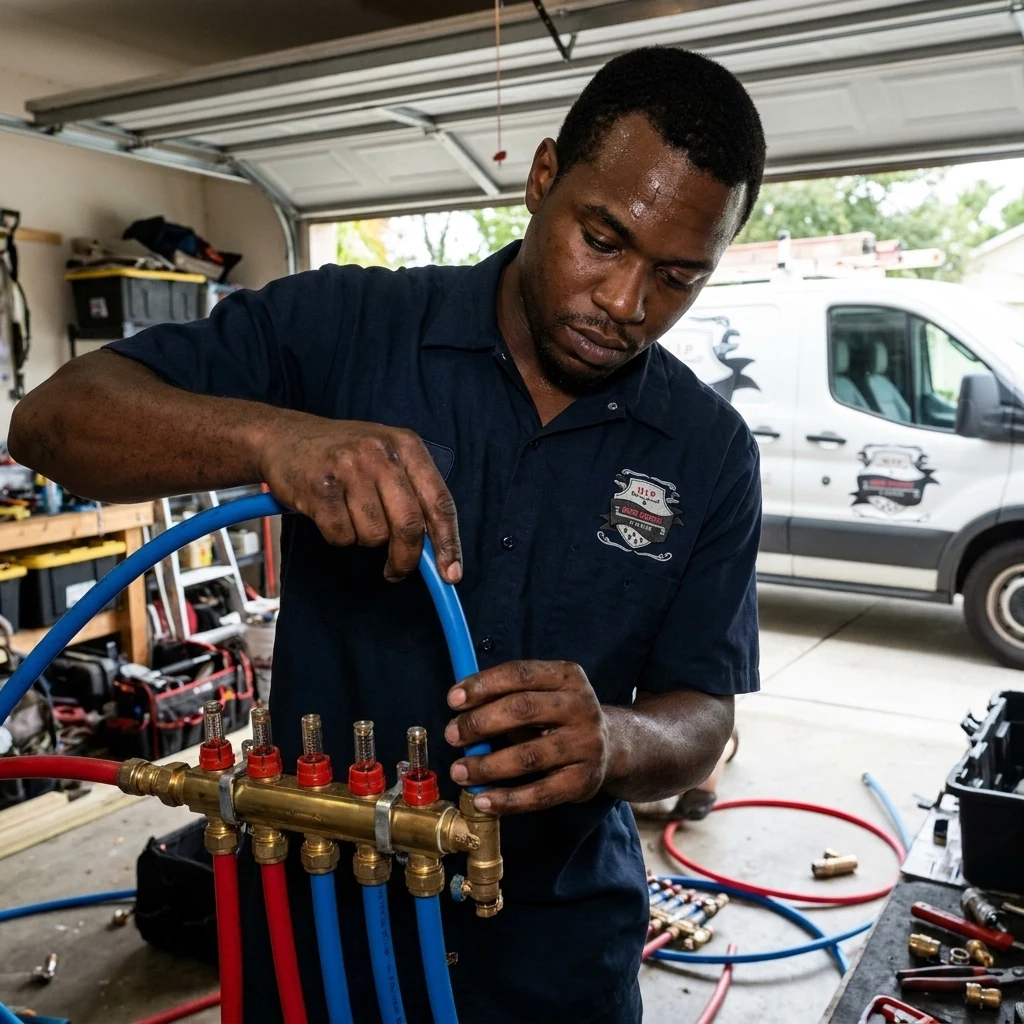
Pinhole Leaks, Polybutylene and the Repipe Question
Homeowners hold 68.5 percent of occupied units and 59.2 percent of units are detached houses, so the person choosing between a patch and a repipe is usually the person paying for it. A single pinhole in accessible copper is a repair. Repeated leaks in different rooms, or flexible gray plastic behind the heater, are a different conversation.
Whole-house PEX repipes typically run $4,500 to $12,000, and for anything over about $1,500 we would rather you collected a second written quote. Our cost guide shows how scope changes the price, and the plumbing section of a 4-point inspection explains why insurers ask about supply-pipe type. Both leak detection and repiping start with identifying the material.
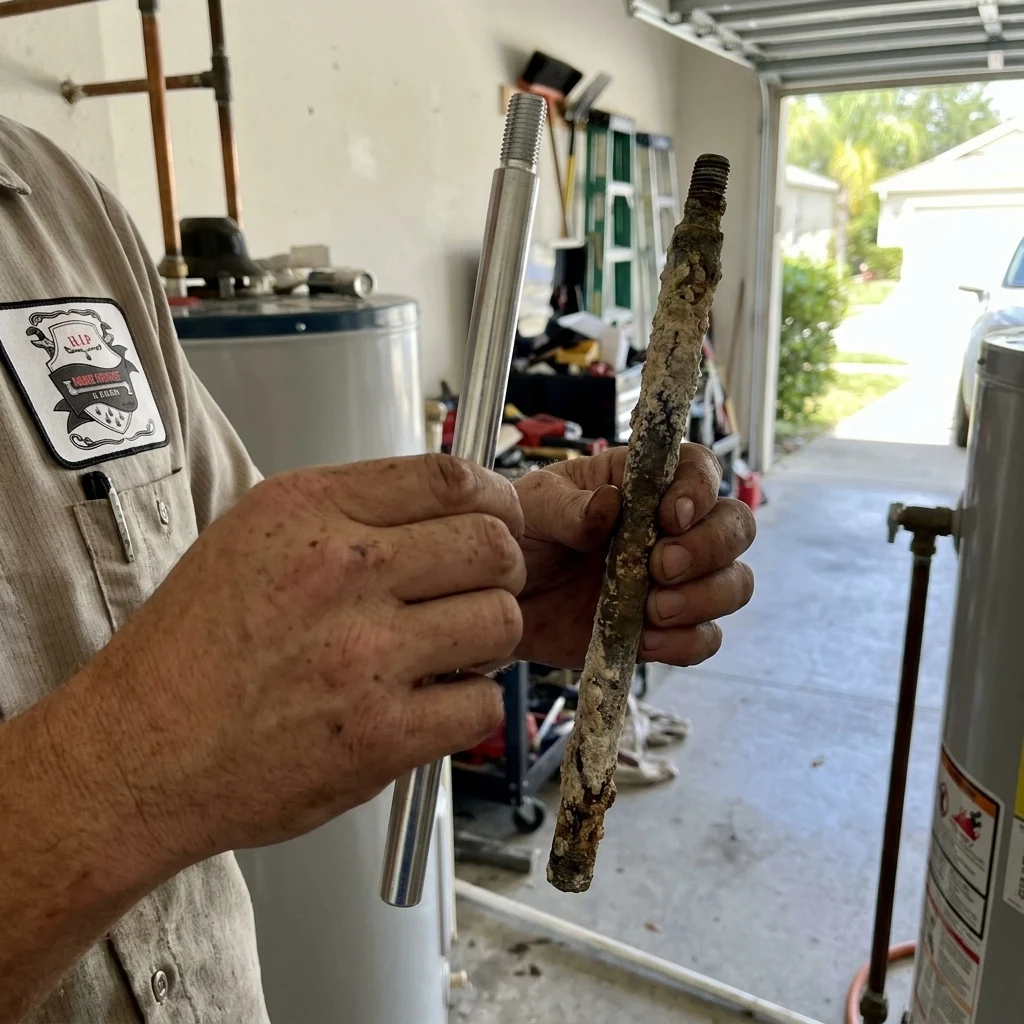
Services for the Village-Era Houses
- Emergency Plumbing Repairs — A burst fitting in a 1980s Village house gets the water shut off at the main, then a written price for the repair.
- Plumbing Repairs — Pinholes, tired toilet parts and corroded shutoffs are the standard repairs, each paired with a look at the supply pipe's material.
- Plumbing Installation — Bath remodels in 1980s houses start by finding the original drain locations and checking the existing valves.
- Leak Detection — A Carrollwood pinhole behind drywall is located with equipment first, so the wall opening is the size of the leak.
- Water Heater Repair & Replacement — A second or third tank in a house built in 1984 is common, so replacements here often come with a new expansion tank.
- Repiping (PEX) — The repipe conversation here is about a build-year window, not a rumor; we confirm the pipe before suggesting PEX.
- Drain Cleaning & Hydro Jetting — County sewer reaches this area through the Northwest plant; inside the house, we snake and camera the lines that are the owner's.
County Water and the Neighborhoods It Serves
Hillsborough County Water Resources' Northwest system serves all five points a county utility map check sampled here, using chloramine at an average of 3.2 ppm. Main-side emergencies go to the county's line at 813-307-1000, which also takes after-hours and weekend emergencies; the house side is ours.
The Village subdivisions, such as Springwood, Chadbourne, Parkwood and Mill Pond, were built between 1978 and 1985, while the original Carrollwood units near Lake Carroll date to the 1960s. Neighbors on Lake Magdalene and in Egypt Lake-Leto have their own housing mix.
Carrollwood Villages and Subdivisions by Build Year
Carrollwood grew from 1959 outward, and its village and subdivision names line up closely with the decade of the plumbing inside.
- Carrollwood Subdivision, Units 1-28 — The original 1959-72 core; Unit 1 has 118 homes averaging 1963, the likeliest place for galvanized or cast-iron lines.
- Carrollwood Village — Village sections I-XXIII, from Section 1 Unit 2 (69 homes averaging 1975) to Village XXIII (53 homes averaging 1985).
- Cherry Creek, Units 1-4 — 125 homes built 1973-75, in the stretch of the 1970s just ahead of the nationwide polybutylene era.
- Mill Pond Village — 125 homes averaging 1978, at the start of the nationwide polybutylene period.
- Springwood Village — 160 homes averaging 1980; if the supply piping is original, it is about 45 years old.
- Country Run — Units 1 and 2 hold 245 homes averaging 1984, inside the polybutylene window of roughly 1978-97.
- Stonehedge — 154 homes averaging 1984, so supply lines original to the houses are more than 40 years old.
- Hampton Park, Units 1-4 — 297 homes built 1985-89, a large late-1980s group that sits inside the polybutylene window.
- Carrollwood Landings — Phases 1-3 were built 2020-24, among the newest homes in Carrollwood and well past the polybutylene era.
Dale Mabry, Busch and the Lakes: Reference Points in Carrollwood
One state highway, three cross streets and two lakes cover most of how Carrollwood addresses get described.
- Dale Mabry Highway (SR 597) — Runs from Busch Boulevard and Gunn Highway north to US 41, passing Bearss Avenue and West Fletcher Avenue.
- Busch Boulevard — Marks the south end of the Carrollwood area, near where Dale Mabry Highway begins at Gunn Highway.
- Bearss Avenue — East-west corridor crossing Dale Mabry in the northern half of Carrollwood.
- West Fletcher Avenue — Crosses Dale Mabry Highway on the way toward the University area.
- Lake Magdalene — Sits on Carrollwood's northern boundary and gives its name to the neighboring census area.
- Lake Carroll — A historic reference point; more than 900 homes were built near it between 1959 and 1970.
- Carrollwood Country Club — Built in 1972 and listed in Carrollwood's Wikipedia entry among its landmarks.
- Carrollwood Elementary — Built in 1963, the same decade as the original subdivision units.
Carrollwood's Polybutylene-Era Numbers and County Water Facts
Carrollwood's utility is Hillsborough County's Northwest system, so these figures come from the county's 2025 report and parcel records.
- Of 8,068 single-family parcels in Carrollwood, 5,281 (65.5%) were built between 1978 and 1997. That window overlaps the national polybutylene period (roughly 1978 to 1995), so a pinhole leak or repipe question should start with what the supply pipe is made of.
- County Northwest water is disinfected with chloramine at a 3.2 ppm average, in a reported range of 0.2 to 5.3 ppm. Chloramine is documented to degrade polybutylene and acetal fittings and tends to age rubber seals, which gives 1980s homes two reasons to have supply fittings checked.
- Carrollwood's single-family median build year is 1981, and only 1.5% of the parcels predate 1960. This is a mid-vintage market, so the work leans toward aging copper, CPVC and 1980s fixtures rather than galvanized steel.
- Owners occupy 68.5% of Carrollwood's 14,543 occupied homes, and 19.7% of units are in buildings of five or more. Homeowners making their own repair-or-replace decisions account for most of the demand, with apartment and condo owners a smaller share.
- The county found no lead service lines in the Northwest system, which reported a lead 90th-percentile of 0.75 ppb. Lead is not the main concern for most Carrollwood homes; the age and material of the pipes inside the house is.
- Hillsborough County Water Resources lists one number, (813) 307-1000, for customer service and for after-hours and weekend emergencies. A break at or before the meter belongs to the county, while a leak after it is the owner's, so locating the shutoff and meter comes first.
Carrollwood 33618 or 33624: found a pinhole?
Shut the water at the main, then text us a photo of the spot and the pipe nearby. We can often tell from the picture whether you are looking at a repair or the first sign of a repipe.
CALL 813-733-7188Pinhole, Polybutylene and Heater Questions in Carrollwood
Check the supply lines near the water heater and the main shutoff. Polybutylene is flexible gray, silver-blue or black plastic, often stamped PB. Copper is brown, CPVC cream, PEX red, blue or white. Material is confirmed on site before a repipe is quoted.
One pinhole in an accessible line is a repair, typically $350-$900 if a wall must be opened. A second or third in a different room suggests the pipe is failing along its length, and the repipe cost starts to make sense. We tell you which pattern we see.
Chloramine can age rubber flappers and seals faster than plain chlorine does. The county averaged 3.2 ppm in 2025. That is a reason to replace worn toilet innards on a schedule, not a reason for alarm, and a typical rebuild runs $125-$350.
Tank heaters commonly run 8 to 12 years, so a house that old has been through several. If yours is past 10 years or has no sign of an expansion tank, we recommend planning replacement, which runs $1,200-$2,500 installed.
A leak at or before the meter belongs to Hillsborough County Water Resources, whose customer service and after-hours emergency line is 813-307-1000. A leak after the meter is the owner's, and that is where leak detection starts. We can help you tell which side you are on.
Close by, With Similar and Different Housing
Lake Magdalene
Just northeast, sharing the lake-dotted ground, with its southern streets on Tampa's utility instead of the county's.
Egypt Lake-Leto
South along Dale Mabry, where the housing is two decades older and half the households rent.
Lutz
Further up Dale Mabry, on larger lots where some addresses are on wells and septic tanks.
Forest Hills
East of Carrollwood, a neighborhood of 1950s ranches around the Zaharias golf course, on Tampa's utility.